

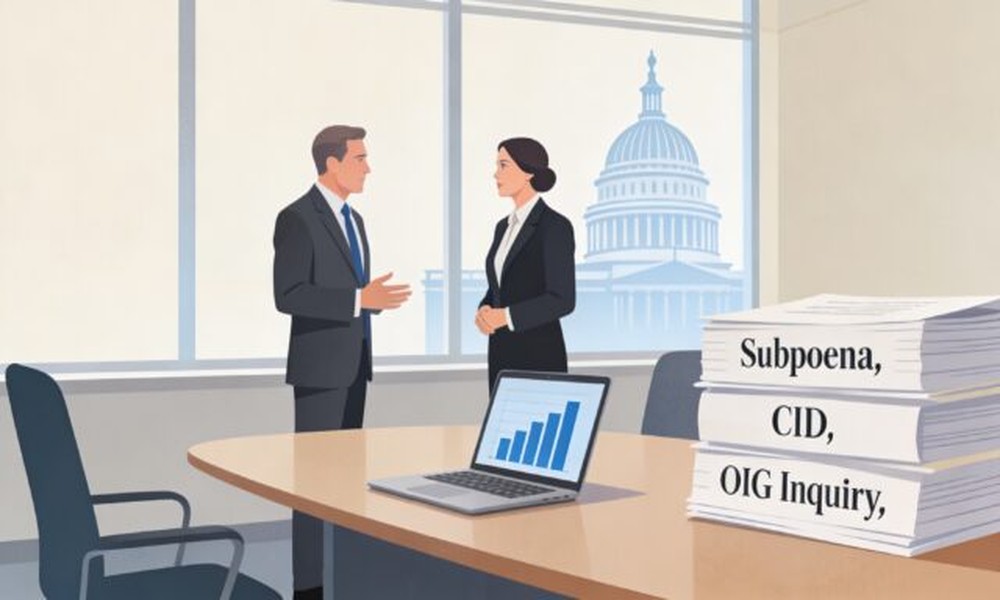
A program manager at HHS receives a phone call from the agency’s Office of Inspector General asking to schedule an interview about a contracting matter. A Treasury employee gets an email from TIGTA requesting an interview about her supervisor’s handling of taxpayer information. A DoD civilian at the Pentagon is told that DoD OIG would like to speak with her, and she has a few days to think about it. The instinct in each case is to comply and explain. Federal employees are honest people who generally believe that telling the truth straightforwardly will be enough. That instinct is right about telling the truth and wrong about everything else. A Washington DC federal employee attorney who handles IG investigations can help a federal worker prepare for an interview that may produce consequences far beyond what the request letter suggests, and the preparation matters most before the interview happens, not after.
Why Inspector General Investigations Matter
The Inspector General Act of 1978, codified at 5 U.S.C. App. 3, established Offices of Inspector General at most federal agencies. Today, nearly every Cabinet department, independent agency, and major federal entity in D.C. has its own OIG, with broad authority to investigate fraud, waste, abuse, mismanagement, and misconduct.
OIG offices in D.C. include OIG offices at HHS, DoD, Treasury (TIGTA), DOJ, State, DHS, VA, EPA, NASA, GSA, OPM, USPS OIG, the Inspectors General for the Intelligence Community, and many more. Each operates with statutory independence from the agency it oversees, although it sits within the agency for administrative purposes.
What an IG investigation produces depends on the findings. Substantiated misconduct can result in administrative discipline (referred to the agency’s HR office or relevant disciplinary authority), referral to the Department of Justice for criminal prosecution, referral to the Office of Special Counsel for prohibited personnel practices, referral to the Office of Government Ethics for ethics violations, referral to a state bar for attorney misconduct, or referral to professional licensing bodies for other regulated professions.
The same interview transcript can be used in administrative discipline, criminal prosecution, civil litigation, ethics proceedings, and bar discipline. What an employee says in an IG interview echoes for years.
The Obligation to Cooperate
Federal employees have a general obligation to cooperate with IG investigations, and refusal to cooperate can itself produce discipline. The leading framework comes from cases like Weston v. HUD, 724 F.2d 943 (Fed. Cir. 1983), and a body of MSPB precedent recognizing that an employee can be required to answer questions about official conduct as a condition of continued employment.
Cooperation, however, is not the same as making any statement that’s asked for. Federal employees retain several important rights even within the obligation to participate in an investigation.
The right to counsel. Federal employees can be represented by counsel during IG interviews. Some IG offices require advance notice of representation; most accommodate counsel without resistance.
The right to know whether the interview is voluntary or compelled. Voluntary interviews can be terminated. Compelled interviews carry the Garrity protections discussed below.
The right to know whether the employee is a subject, witness, or person of interest. The IG’s understanding of the employee’s role in the matter affects the questions asked and the consequences of answers given.
The right to an accurate transcript or record of the interview. Some IG offices record interviews; others rely on agent notes. Reviewing what’s been recorded matters.
Garrity Protections in Compelled Statements
When an IG investigator compels a statement under threat of disciplinary action for refusal, Garrity v. New Jersey, 385 U.S. 493 (1967), prohibits the use of that statement in subsequent criminal prosecution against the employee. The compelled statement can still be used in administrative discipline, civil litigation, and most other proceedings.
For Garrity protection to apply, several elements typically need to be present:
The employee must be advised that refusal to answer can result in administrative discipline.
The questions must be specifically directed and related to the official conduct under investigation.
The questioning must be sufficiently coercive that the employee’s statement is properly understood as compelled rather than voluntary.
When Garrity applies, the statement is “use immune” in subsequent criminal proceedings. Derivative-use immunity (under Kastigar v. United States, 406 U.S. 441 (1972)) extends to evidence derived from the compelled statement, although the line between protected and unprotected evidence is heavily litigated.
What’s important to understand: Garrity protects against criminal use, not administrative use. Statements made in IG interviews routinely become the foundation of subsequent disciplinary action, and the employee gains no protection against that use simply because the interview was compelled.
How IG Findings Get Used
After completing an investigation, the OIG typically prepares a Report of Investigation (ROI). The ROI may be:
Referred to DOJ for criminal prosecution if the conduct involves a federal crime.
Referred to the agency’s HR or disciplinary office for administrative action against the employee.
Referred to OSC for action under prohibited personnel practices or Hatch Act provisions.
Referred to OPR (at DOJ) for attorney misconduct cases.
Referred to OGE for ethics violations.
Referred to state bar disciplinary authorities for attorneys subject to bar admission.
Referred to professional licensing bodies for licensed professionals.
Made available publicly in some form (with redactions) under Inspector General Act transparency provisions.
The same investigation can produce multiple parallel proceedings, and the strategic implications are substantial. A statement made in an IG interview can simultaneously affect a criminal investigation, an administrative removal proceeding, a civil suit, and a bar discipline matter.
When to Invoke Counsel
The instinct to “just answer the questions” often produces problems that didn’t have to exist. A few factors that suggest counsel involvement before an IG interview:
The matter involves potential criminal exposure. Even when criminal prosecution seems unlikely, statements made in IG interviews have a way of finding their way to U.S. Attorney’s Offices, and once made, they can’t be unmade.
The employee is a subject or person of interest, not merely a witness. Subjects need different preparation than witnesses, and counsel can clarify the role.
The matter involves complex factual patterns that benefit from preparation. Spontaneous answers to detailed questions about events that happened months ago routinely produce inaccuracies that the IG report treats as evasions or false statements.
The employee holds a security clearance. Clearance issues under Guideline E (Personal Conduct) often turn on truthfulness in official inquiries, and statements made without preparation can produce clearance consequences independent of the underlying matter.
The employee is a licensed professional whose bar or licensing body could be informed of the investigation. The interaction between IG findings and professional licensing is technical.
The matter involves whistleblower disclosures or protected activity. The IG investigation may itself be retaliatory, and counsel can help frame the cooperation in ways that preserve WPA claims.
Specific Issues With OPR and OSC Referrals
OPR investigates DOJ attorneys. IG referrals to OPR (or vice versa) trigger the framework discussed in connection with DOJ attorney discipline, with PMRU adjudication, MSPB review for those who qualify, and bar discipline implications.
OSC investigates prohibited personnel practices and Hatch Act violations. IG referrals to OSC, or OSC referrals to an IG, can produce parallel investigations with different procedural rules and different remedial frameworks.
Coordinated representation across these forums is technical and benefits from counsel familiar with each.
Practical Steps Before the Interview
Don’t agree to a date until you’ve consulted counsel. IG offices generally accommodate reasonable scheduling.
Save every document related to the underlying matter. Litigation holds may apply, and document destruction can produce its own discipline.
Don’t discuss the investigation with coworkers. Communications about the investigation can be discoverable, and IG agents sometimes interview multiple employees about the same events.
Avoid discussing the matter on agency systems.
Identify any parallel proceedings (clearance review, EEO matters, OSC complaints, bar matters) that the IG investigation may affect.
Federal employees across the Cabinet departments and independent agencies in D.C. encounter IG investigations regularly. Each agency’s OIG operates with somewhat different practices, and counsel familiar with the specific OIG can adjust preparation accordingly.
For background, ignet.gov publishes the Council of the Inspectors General on Integrity and Efficiency materials, individual OIG sites publish their procedures and reports, and 5 U.S.C. App. 3 contains the substantive Inspector General Act framework.
Talk to a Washington DC Federal Employee Attorney Before You Sit Down With the OIG
IG investigations reward preparation, and the preparation has to happen before the interview. A Washington DC federal employee attorney who has represented federal workers before HHS OIG, DoD OIG, TIGTA, DOJ OIG, State OIG, DHS OIG, VA OIG, and the other Cabinet department and independent agency OIGs can help an employee understand the role, prepare for the questions, identify the parallel proceedings the matter may produce, and protect the procedural posture for any subsequent discipline. If you’ve received an IG interview request, contact counsel before scheduling the interview.
